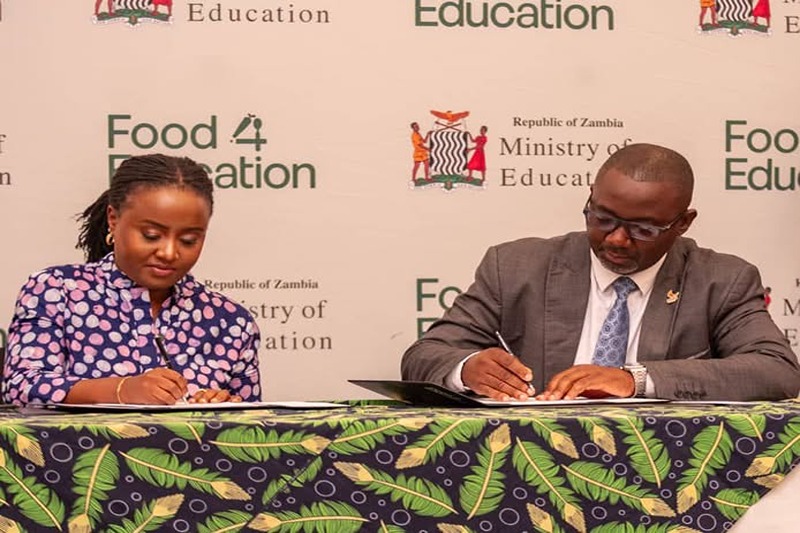
Zambia has signed a landmark agreement with Kenya-based social enterprise Food4Education to expand its national school feeding program, aiming to reach 5.6 million learners by the end of 2026 as African nations increasingly view childhood nutrition as vital economic infrastructure.
The Memorandum of Understanding (MoU), signed by Zambia’s Ministry of Education, establishes a long-term technical cooperation framework to scale the program from its current reach of 4.6 million students. The initiative follows the country’s 2022 Free Education Policy, which flooded public schools with an additional two million learners and triggered unprecedented demand for state-backed meal programs.
Under the pact, Food4Education will provide technical support across five core pillars: policy coordination, operational systems, digital innovation, financing, and infrastructure development. The enterprise will not directly manage food distribution; instead, it will focus on digitizing and upgrading Zambia’s existing state-led systems.
“Universal school feeding is an investment in our children’s futures and our nation’s economic growth,” said Dr. Kelvin Mambwe, Zambia’s Permanent Secretary for Education Services. “This partnership with Food4Education helps us strengthen the systems that turn this investment into long-term returns for Zambia.”
The economic stakes are high for a continent where childhood hunger drains an estimated 16.5% of Gross Domestic Product annually, according to data cited by Food4Education. Conversely, structured school feeding initiatives can generate up to $20 in broader economic returns for every dollar invested by boosting local agriculture, formalizing supply chains, and keeping children in classrooms.
Food4Education brings over 14 years of operational experience to the partnership, having served over 200 million meals in Kenya. The group expects to leverage its proprietary “Tap2Eat” digital platform to optimize Zambia’s supply chain, streamline millions of meal transactions, and link local smallholder farmers to reliable government markets.
The strategy reflects an emerging trend of African governments financing large-scale social safety nets directly through domestic treasuries rather than relying solely on foreign aid.
“Zambia is doing something that the continent needs to see,” said Wawira Njiru, Founder and Chief Executive Officer of Food4Education. “It is putting its own treasury and the weight of several ministries behind its own children, building school feeding as economic infrastructure that strengthens agriculture, creates dignified livelihoods, builds human capital, and grows the economy.”
The deal significantly elevates Zambia’s profile ahead of November 2026, when the country is slated to host the Global Child Nutrition Forum. The international summit will serve as a testing ground for policy experts, development partners, and regional governments looking to replicate sustainable, state-led nutrition models across sub-Saharan Africa.