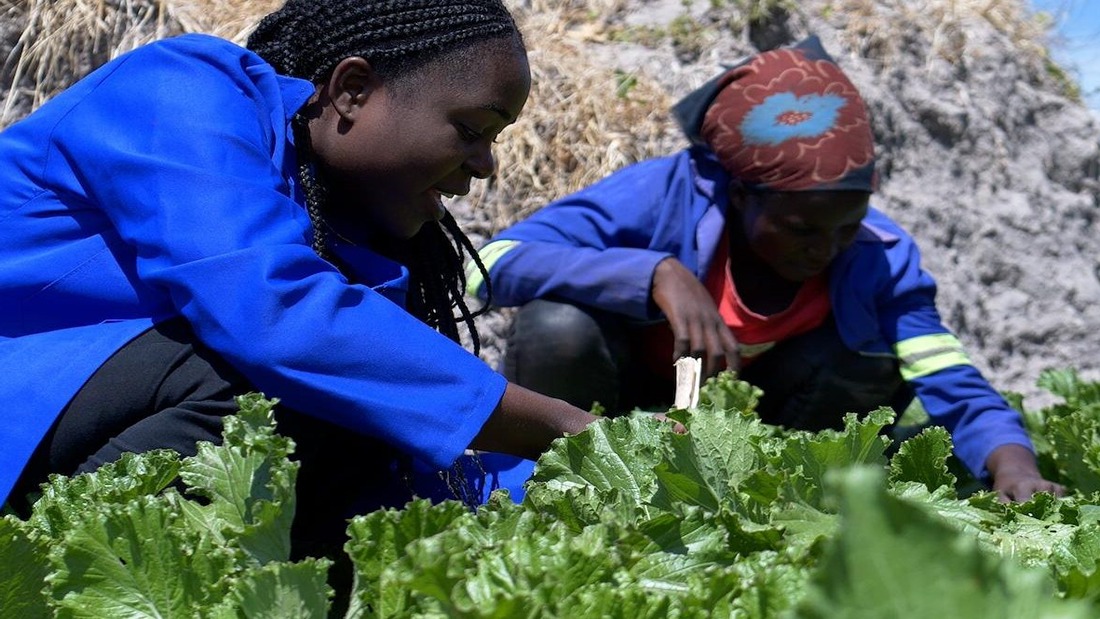
In the red-dirt countryside of Chipata, nestled in eastern Zambia, the rhythm of life has long been dictated by unpredictable skies, exhausted soils, and backbreaking traditional labor. For generations, smallholder farmers worked tirelessly for unpredictable rewards. But across these rolling landscapes, a quiet revolution is taking root one led by local women who are rewriting their families’ futures through sustainable, climate-smart agriculture.
For years, local farmer Sarah Phiri found her income bounded by antiquated methods and erratic rainfall. Today, her fields tell a remarkably different story. By adopting simple, sustainable techniques designed to restore soil health and conserve moisture, Phiri has fundamentally transformed her household’s economic trajectory.
“I grow beans, maize, sunflower, and wheat. Using climate smart farming techniques has resulted in better harvests than the traditional methods we used for years. As a result, I can now send all my children to school without difficulty, and we store enough food to last the whole year.” said Sarah Phiri, Farmer in Chipata
The transition to climate-smart farming centers on practical, accessible technologies: precision planting, minimum tillage (ripping), crop rotation, intercropping, and agroforestry. Rather than requiring heavy capital or expensive chemical inputs, these methods work in harmony with the local ecosystem, lowering labor demands while enhancing biodiversity and restoring degraded land.
For Mirriam Lungu, another smallholder who embraced the training, the single biggest revelation was how accessible these high-yield techniques turned out to be.
“Climate smart agriculture has simplified farming. It does not require hard labor, and even when I cultivate a small piece of land, the harvest exceeds expectations. These lessons have also shown us how to make the land fertile even when we do not have money to buy fertilizer.” said Mirriam Lungu, Farmer in Chipata
This transformation was sparked by the Zambia Integrated Forest Landscape Project (ZIFLP) a collaborative initiative spearheaded by the Government of Zambia alongside the World Bank, the BioCarbon Fund ISFL, the Global Environment Facility, and local communities. Designed to expand economic benefits while safeguarding forest ecosystems, ZIFLP aligns directly with AgriConnect, a broader World Bank Group vision aimed at transforming agriculture for 300 million smallholders globally.
The impact extends far beyond individual plots. In rural Zambia, women make up the majority of the agricultural workforce, yet historically faced the steepest barriers to resource access, land productivity, and climate resilience. As women master these techniques, the dividends ripple across entire villages.
“Adopting climate smart agriculture has greatly improved our efficiency, increased our harvests, and strengthened our food security. Our lives have changed, and we now teach others how to farm this way.” said Gracious Lungu, Local Farmer’s Cooperative Leader
With consistent harvests, families eat better, store surplus for lean months, and gain an independent source of self-employment. The additional income directly flows into vital social investments paying school fees, securing medical care, and creating financial cushions against future climate shocks.
“The influence extends beyond individual households. As more women adopt these methods, entire communities benefit from increased productivity and resilience. With higher yields and more stable incomes, families can invest in education and healthcare, strengthening the social fabric of the region.” said Silvia Mauri, World Bank Senior Agriculture Specialist
In Chipata, female farmers are no longer merely adapting to climate change they are stepping up as community educators, leaders, and drivers of regional stability. Their success offers a compelling proof point for rural development: when rural women are equipped with knowledge, sustainable tools, and opportunity, they become the catalyst for community-wide transformation.